Compare
Fujinon XF14mmF2.8 R vs Fujinon XC13-33mmF3.5-6.3 OIS
Short answer
The Fujinon XF14mmF2.8 R (14mm) and Fujinon XC13-33mmF3.5-6.3 OIS (13–33mm) are both wide-angle lenses for the Fujifilm X mount. The Fujinon XF14mmF2.8 R is the faster lens at f/2.8 against f/3.5–6.3 on the Fujinon XC13-33mmF3.5-6.3 OIS. Only the Fujinon XF14mmF2.8 R has an aperture ring. Only the Fujinon XC13-33mmF3.5-6.3 OIS has optical stabilisation.
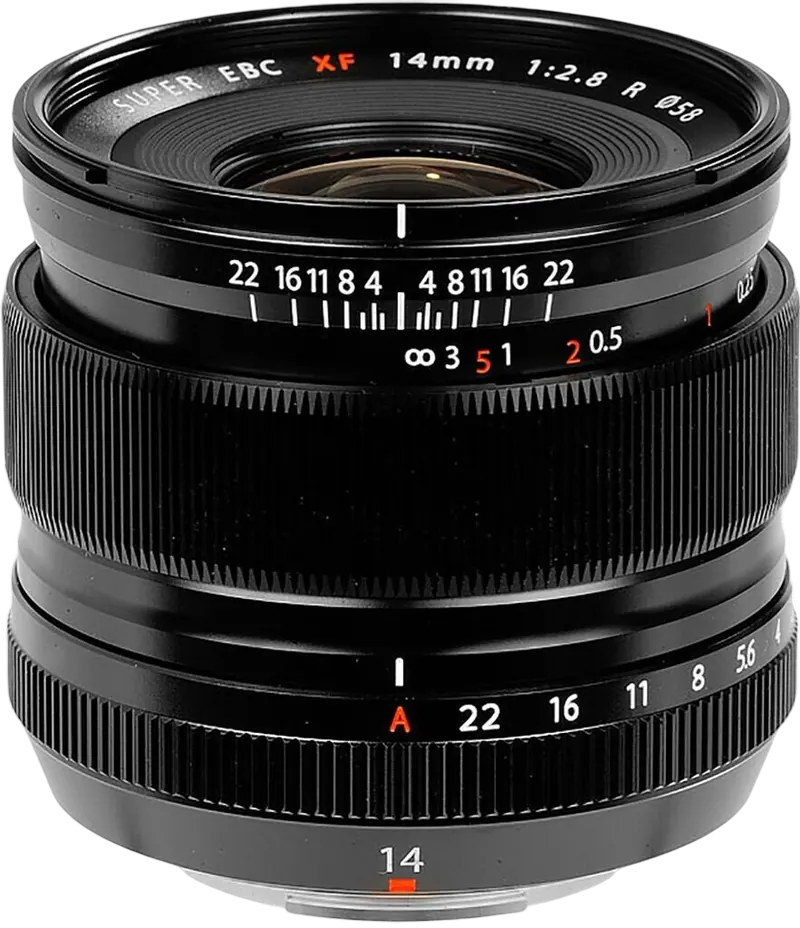
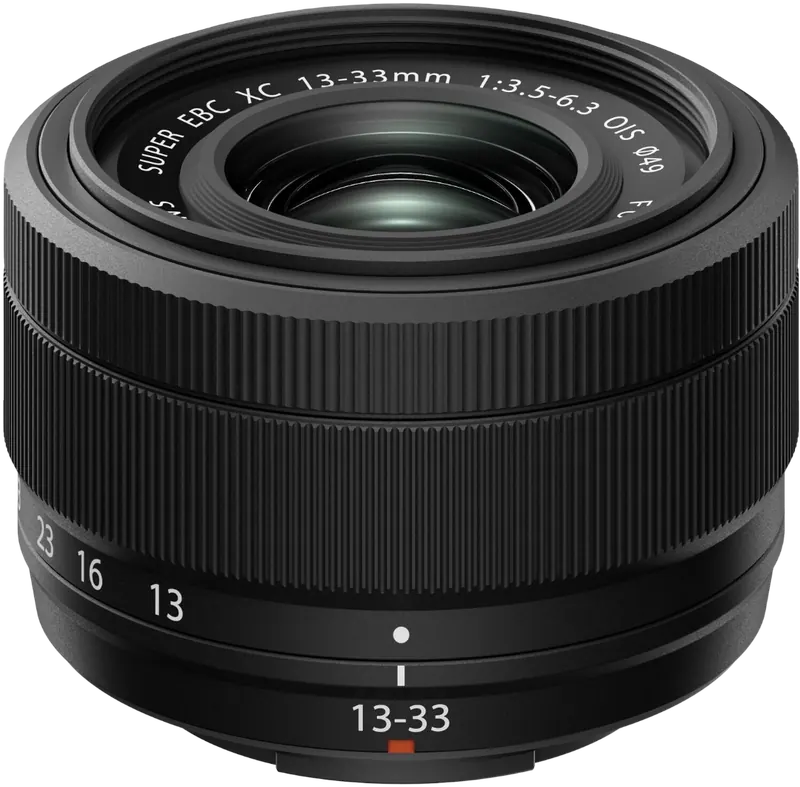
Fujinon XC13-33mmF3.5-6.3 OIS: 5 specs ahead
Side by side
| Fujinon XF14mmF2.8 R | Fujinon XC13-33mmF3.5-6.3 OIS | |
|---|---|---|
| Brand | Fujifilm | Fujifilm |
| Focal length | 14mm | 13–33mm |
| 35mm equivalent | 21mm | 20–50mm |
| Maximum aperture | f/2.8 | f/3.5–6.3 |
| Mount | Fujifilm X | Fujifilm X |
| Autofocus | Yes | Yes |
| Optical stabilisation | No | Yes |
| Weather resistant | No | No |
| Aperture ring | Yes | No |
| Macro | No | No |
| Linear motor | No | No |
| Minimum aperture | f/22 | f/22 |
| Aperture blades | 7 | 9 |
| Lens construction | — | 10 elements in 9 groups |
| Special elements | — | 4 aspherical and 3 ED elements |
| Angle of view | 90.8° | 95.1°-46.6° |
| Minimum focus | 0.18 m | 0.2 m |
| Maximum magnification | 0.12× | 0.25× |
| Weight | 235 g | 125 g |
| Diameter | ⌀65 mm | ⌀61.9 mm |
| Length | 58.4 mm | 37.5–57.2 mm |
| Filter thread | ⌀58 mm | ⌀49 mm |
Where each one is ahead
Reasons to choose the Fujinon XF14mmF2.8 R
- Maximum aperture f/2.8 vs f/3.5–6.3
- Aperture ring Yes vs No
- Minimum focus 0.18 m vs 0.2 m
Reasons to choose the Fujinon XC13-33mmF3.5-6.3 OIS
- Longer reach 50 mm vs 21 mm
- Optical stabilisation Yes vs No
- Maximum magnification 0.25× vs 0.12×
- Weight 125 g vs 235 g
- Diameter ⌀61.9 mm vs ⌀65 mm
- Length 37.5–57.2 mm vs 58.4 mm
Neither has weather sealing, a macro design, and a linear focus motor.
Framing and reach
| Lens | Frames like | Horizontal view | Frame width at 10 m |
|---|---|---|---|
| Fujinon XF14mmF2.8 R | 21 mm | 80° | 16.8 m |
| Fujinon XC13-33mmF3.5-6.3 OIS | 20–50 mm | 84.2°–39.2° | 18.1–7.1 m |
The Fujinon XC13-33mmF3.5-6.3 OIS gets 2.38× closer to the subject than the Fujinon XF14mmF2.8 R: whatever it points at fills 2.38× more of the frame edge to edge, or 5.7× more of its area. With the Fujinon XF14mmF2.8 R you would have to walk about 58% of the distance towards the subject to get the same picture — or crop it later, which leaves roughly 18% of the original pixels.
Angles and widths are calculated from focal length and sensor width, horizontally, on the native sensor of each mount.
Size and weight
- The Fujinon XC13-33mmF3.5-6.3 OIS is 110 g lighter than the Fujinon XF14mmF2.8 R, about 47% less.
- The Fujinon XF14mmF2.8 R is 20.9 mm longer.
- The Fujinon XF14mmF2.8 R is 3.1 mm wider.
- The Fujinon XF14mmF2.8 R takes ⌀58 mm filters and the Fujinon XC13-33mmF3.5-6.3 OIS ⌀49 mm, so filters are not shared.
What each one suits
| Fujinon XF14mmF2.8 R | Fujinon XC13-33mmF3.5-6.3 OIS | |
|---|---|---|
| Birds and wildlife | Poor | Poor |
| Sports | Poor | Poor |
| Portrait | Poor | Poor |
| Travel | Very good | Excellent |
| Street | Very good | Very good |
| Weddings | Good | Very good |
| Walk around | Good | Excellent |
| Vlogging | Very good | Excellent |
| Landscape | Good | Good |
| Macro | Poor | Poor |
Scored from the published specifications — focal length, aperture, stabilisation, weather sealing and weight. Sharpness, bokeh and rendering are not in a spec sheet and are not scored here.
Cameras that take both
Both lenses fit every interchangeable-lens X Series body — 34 in our list. Fixed-lens models such as the X100 series cannot take them.
Which one to choose
Choose the Fujinon XF14mmF2.8 R if
- low light is the priority. At f/2.8 it lets in 0.6 stops more than f/3.5–6.3 — faster shutter speeds indoors and softer backgrounds.
Choose the Fujinon XC13-33mmF3.5-6.3 OIS if
- your subject is far away. It magnifies 2.38× more, and walking closer is not always an option.
- your camera body is not stabilised. Of these two, only this lens has optical stabilisation.
- you photograph small things up close. It reaches 0.25× magnification, compared with 0.12×.
- weight matters to you. It is 110 g lighter, roughly 47% less to carry.
Everything above comes from published specifications. How sharp each lens is, how quickly it focuses and what its pictures look like are not in any spec sheet, so this comparison does not try to judge them.
Common questions
Which is lighter, the Fujinon XF14mmF2.8 R or the Fujinon XC13-33mmF3.5-6.3 OIS?
The Fujinon XC13-33mmF3.5-6.3 OIS, by 110 g — about 47% less.
Which is better in low light, the Fujinon XF14mmF2.8 R or the Fujinon XC13-33mmF3.5-6.3 OIS?
The Fujinon XF14mmF2.8 R. At f/2.8 against f/3.5–6.3 it gathers 0.6 stops more light, which matters without flash and for background blur. Stabilisation can offset some of that for still subjects, but not for moving ones.
Do the Fujinon XF14mmF2.8 R and Fujinon XC13-33mmF3.5-6.3 OIS use the same filters?
No. The Fujinon XF14mmF2.8 R takes ⌀58 mm and the Fujinon XC13-33mmF3.5-6.3 OIS ⌀49 mm. A step-up ring lets the smaller lens use the larger filters.
Will both lenses fit my camera?
Both use the Fujifilm X mount, so they fit any X Series camera with interchangeable lenses. They do not fit fixed-lens models such as the X100 series or GFX bodies.
compare.faqTitle
Which one is lighter?
The Fujinon XC13-33mmF3.5-6.3 OIS, by 110 g (125 g against 235 g).
Which is better, the Fujinon XF14mmF2.8 R or the Fujinon XC13-33mmF3.5-6.3 OIS?
On measurable specs the Fujinon XC13-33mmF3.5-6.3 OIS leads, 5 wins against 3. That is a spec count, not a field test.
Owner reviews
No reviews yet. Be the first to write one.
Built from the specifications Fujifilm publishes.