Gear · 7 min read
instax Pal 2: What Changed and What It Costs
A viewfinder, 10 MP, a 28mm lens, and a Bluetooth catch worth knowing.
Short answer
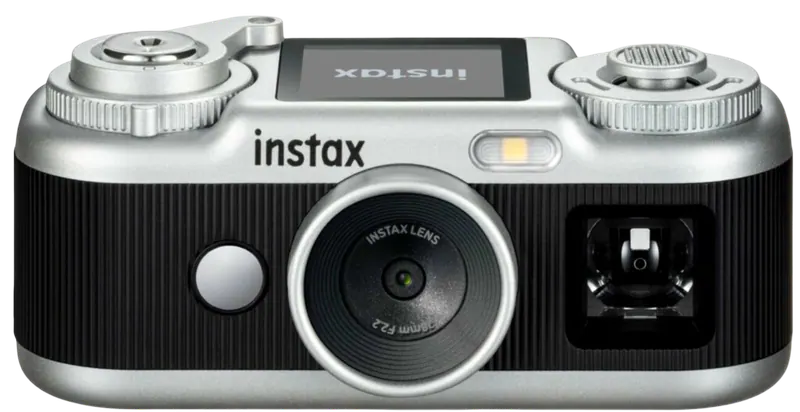
The instax Pal 2 is a pocket digital camera that does not print; photos go to an instax Link printer or an Evo. It adds an optical viewfinder, 10 MP (up from about 5), a 28mm-equivalent f/2.2 lens, 30 effects and USB-C transfer. It costs $169.95 / €169.99 from late September 2026, and is larger than the original at about 87 g.
Fujifilm has replaced the round, ultra-wide instax Pal with something that looks and handles like a camera. Here is what actually changed, by the numbers from Fujifilm’s own announcement and specification sheet, including two things the launch copy does not lead with: it is twice as heavy, and Bluetooth only sends a 1 MP file.
What the Pal 2 is
Fujifilm announced the instax Pal 2 on 15 September 2026. It is the successor to the instax Pal from October 2023, and it keeps the same idea: a small digital camera that takes pictures and does not print them.
Removing the printer is what lets it be this small. The prints come later, from a separate device — an instax Link smartphone printer, or one of the hybrid instax Evo and LiPlay cameras. The Pal 2 is the capture half of that pair.
That makes it a different purchase from every other instax camera. You are not buying instant film in a box. You are buying a pocket camera whose photos are designed to end up on instant film.
What changed on the outside
The original Pal was a round, ball-shaped thing you could clip to a bag. The Pal 2 abandons that. It is shaped like a very small conventional camera, with a semi-matte finish and a knurled surface for grip, in black or white.
More importantly, it now has the controls the first one lacked:
An optical viewfinder. The original had none. Framing by eye rather than by guessing is the single biggest usability change.
A monitor on the top for reviewing a shot right after you take it.
A control dial for switching effects, and a lever that selects the frame format and, pushed toward the monitor, switches on the animation mode.
Sensor and lens
The sensor grows to 1/3.06-inch, and resolution doubles: 10 megapixels against about 5 on the first Pal. There is also a 1 MP mode for when you only need a file sized for a print or a phone screen.
The lens change matters more than the megapixels. Fujifilm’s specification sheets list the original Pal at a 16.25mm equivalent and the Pal 2 at 28mm, both at f/2.2. The first Pal was ultra-wide, which suited arm’s-length selfies and awkward angles. The Pal 2 frames like a normal wide lens on a phone — tighter, less distorted, and less forgiving when you hold it close.
The rest of the exposure system is unchanged on paper: automatic shutter from 1/4 to 1/8000 second, automatic ISO 100 to 1600. You do not set any of it.
It is bigger, and twice as heavy
The redesign costs size. By Fujifilm’s own figures:
instax Pal: 42.3 × 44.4 × 43.0 mm, about 41 g.
instax Pal 2: 37.0 × 42.0 × 92.3 mm, about 87 g.
It is still a pocket camera by any normal standard. But it is no longer the near-weightless ball on a keyring, and if that was the appeal of the first model, the second is a different product.
30 effects, six at a time
The Pal 2 has 30 effects split into five themes of six: Modern (natural colour), Y2K (early digital cameras and motion picture film), Vintage, Chromatic (vivid colour and light) and Fantasy.
The camera holds six at once. You choose them in the instax Pal app — either a whole theme, or any six picked across all 30 — and switch between them on the dial while shooting.
Worth being precise for anyone arriving from an X-series body: these are creative effects, not Fujifilm film simulations. Classic Chrome or ACROS are not on the list, and there is no way to load a recipe.
instax Animation
Push the lever toward the monitor and hold the shutter: the camera takes up to 10 consecutive frames and joins them into a short flipbook-style video.
The animation can be printed as a QR code on an instax print, and scanning it plays the clip. The fine print matters here: the video has to be uploaded to Fujifilm’s server through the instax mini Evo app, and it stays downloadable for two years from upload. After that the code on the print leads nowhere.
Storage and getting photos off it
Internal memory doubles to about 100 images, against 50 on the Pal. With a microSD card the limit becomes the card; Fujifilm’s specification lists cards up to 2 TB.
Transfer is where the Pal 2 improves most in daily use. Plugging it into a phone by USB-C moves images at about 0.7 seconds each. That works with iPhones that have a USB-C port on iOS 16 or later, and Android 12 or later.
Bluetooth still works, and there is a catch the marketing does not dwell on. The specification sheet lists Bluetooth transfers at 1280 × 960 pixels and roughly 15 seconds per shot. The full 3776 × 2832 file only comes over the cable. If you want the 10 MP you paid for, use USB.
Formats and printing
You pick one of four formats when you shoot: mini, SQUARE or WIDE with instax frames, or no frame. Choosing at capture means you frame for the print rather than cropping later.
The 10 MP sensor records 3776 × 2832, which is a 4:3 image. That lines up almost exactly with instax mini, which is also about 4:3. Square and wide prints still need a crop — the same arithmetic we walk through in our guide to instax printers.
Compatible devices listed by Fujifilm: mini Link, mini Link 2, mini Link 3 and mini Link+; mini Evo and mini Evo Cinema; mini LiPlay and mini LiPlay+; SQUARE Link; Link WIDE and WIDE Evo. Fujifilm also announced the instax Link Wide 2 printer on the same day.
Price, availability and what is in the box
United States: $169.95, late September 2026.
Canada: C$219.99.
Europe: €169.99, late September 2026.
Japan: 9 October 2026, open pricing.
In the box: a USB-C cable, a hand strap and a camera angle adjustment accessory, which works as a small stand for group shots and hands-free photos. A dedicated camera case follows separately — in Japan, late November 2026.
Who it is for
We have not used a Pal 2 yet, so this is a read of the specification, not a review.
It makes sense if you already own an instax printer or an Evo and want something smaller than a phone to shoot with, specifically for prints. The viewfinder, USB-C transfer and a sensor that matches mini film’s shape are all aimed at exactly that.
It makes less sense if you shoot a Fujifilm X camera. A JPEG from your X body with a recipe applied, sent to the same printer, will look better and carry a real film simulation. The Pal 2 is for the moments when that camera stayed at home.
Common questions
When is the instax Pal 2 available and how much does it cost?
Fujifilm lists $169.95 in the US and C$219.99 in Canada, with availability in late September 2026, and €169.99 in Europe, also late September. In Japan it goes on sale on 9 October 2026 at open pricing.
Does the instax Pal 2 print photos?
No. Like the original Pal, it only takes pictures. Prints come from a separate instax Link smartphone printer, or from a hybrid instax Evo or LiPlay camera.
What is the difference between the instax Pal and Pal 2?
The Pal 2 adds an optical viewfinder, a top monitor, a control dial and a lever. Resolution goes from about 5 MP to 10 MP, internal memory from 50 to 100 images, and the lens from a 16.25mm to a 28mm equivalent. It is also larger and weighs about 87 g against 41 g.
Why are my Pal 2 photos low resolution on my phone?
Probably because they came over Bluetooth. Fujifilm’s specification lists Bluetooth transfers at 1280 × 960 pixels. Connect the camera to your phone with USB-C to receive the full 3776 × 2832 file.
Can the instax Pal 2 use Fujifilm film simulations or recipes?
No. It has 30 creative effects across five themes — Modern, Y2K, Vintage, Chromatic and Fantasy — but not the X-series film simulations, and it cannot load recipes.
Keep reading
Last updated September 15, 2026