Guides · 7 min read
What Is Instax and How Instant Film Works
The chemistry in the white border, the rollers, and why you must not shake it.
Short answer
Instax is Fujifilm’s instant film system, sold in three sizes — mini, square and wide. Each sheet holds three light-sensitive layers plus a reservoir of chemistry in the thick white border; two steel rollers burst it on ejection and spread it across the sheet, developing the print in about 90 seconds. Do not shake it, and keep it out of light for the first minute.
The thick white border is not a frame — it is where the developer lives. This explains what happens in the ninety seconds after the print leaves the camera, why shaking ruins it, how Instax differs from Polaroid, and what the film’s hard limits do to the way the photographs look.
What Instax is
Instax is Fujifilm’s instant film system: a camera, a pack of ten sheets, and a print that appears in your hand a minute after you press the button. It launched in 1998, was nearly discontinued in the mid-2000s, and now outsells every other film product Fujifilm makes.
The name covers both the film and the cameras that take it. It comes in three sizes — mini, square and wide — and a body only takes the size named on it. That is the first thing to know and the thing most people get wrong at the till.
What makes it worth the trouble is not nostalgia. It is that the photograph is a physical object, made once, that nobody has a copy of.
How a print develops in your hand
Each sheet is not paper. It is a sealed sandwich of layers with a reservoir of chemistry along one edge — the thick white border everyone assumes is just a frame.
When you take a photo, light exposes three light-sensitive layers stacked inside the sheet, each recording one colour. So far this is ordinary colour film, and at this point the picture exists but is invisible.
Then the camera pushes the sheet out between two steel rollers. The rollers burst the reservoir and squeeze its contents evenly across the whole sheet in one pass. That is the noise you hear. The chemistry develops all three layers at once and drives the dyes up to the surface where you can see them, and the process stops itself when the reagents are spent.
This is why the rollers matter: they are the developing machine. A blob of dirt on one leaves a stripe down every print you take until you wipe it off.
The first two minutes
The print comes out looking blank pale green. Colour arrives over roughly 90 seconds, and the image keeps settling for a few minutes atfer that.
Do not shake it. This is the single most repeated mistake, borrowed from a song. The chemistry is a wet layer being spread inside a sealed sheet; shaking it moves that layer around and puts blotches in your photograph. Polaroid said not to shake theirs either.
Keep it out of the light for the first minute. Face down on a table, or in a pocket. The sheet is still finishing and bright light during that window washes the result out.
Temperature is the one thing you control. Development is a chemical reaction and it runs on heat. Below about five degrees it stalls and prints come out pale and blue; in real heat it runs fast and goes contrasty. Cold weather has an easy fix — an inside pocket for two minutes.
Why the photos look the way they do
An Instax print is not a bad digital photo. It is a different medium with hard limits, and the limits produce the look.
The film is ISO 800 and the lens is slow and fixed, which is why the flash fires on nearly every frame. Indoors that flash is the only reason the exposure works.
The dynamic range is narrow — far narrower than your phone’s sensor. You cannot hold a bright sky and a face in shadow in the same frame. Something goes white or something goes black, and choosing which is most of the skill.
Colour is warm and slightly soft, with pastel highlights and a gentle roll-off rather than the hard clean contrast a screen gives you. Nobody tuned this to be pretty; it falls out of the chemistry, which is precisely why it cannot be faked convincingly.
Instax and Polaroid are not the same thing
They are both instant film and they are not interchangeable — different sizes, different chemistry, different cameras, and the film of one does not fit the other.
Size. A Polaroid i-Type or 600 print is square and much larger; Instax mini is small enough for a wallet. Instax square is closer in shape to Polaroid but still smaller.
Development. Instax develops in about 90 seconds and is fairly consistent. Polaroid takes several minutes and varies more with temperature and pack age.
Look. Instax is cleaner, sharper and cooler in its rendering. Polaroid is softer and more unpredictable, which people either want badly or do not want at all.
Cost. Instax mini is substantially cheaper per shot than any Polaroid film.
Neither is better. Instax is the reliable one, which is the right answer if you want prints at an event rather than an experiment.
The hybrid cameras, which are a different idea
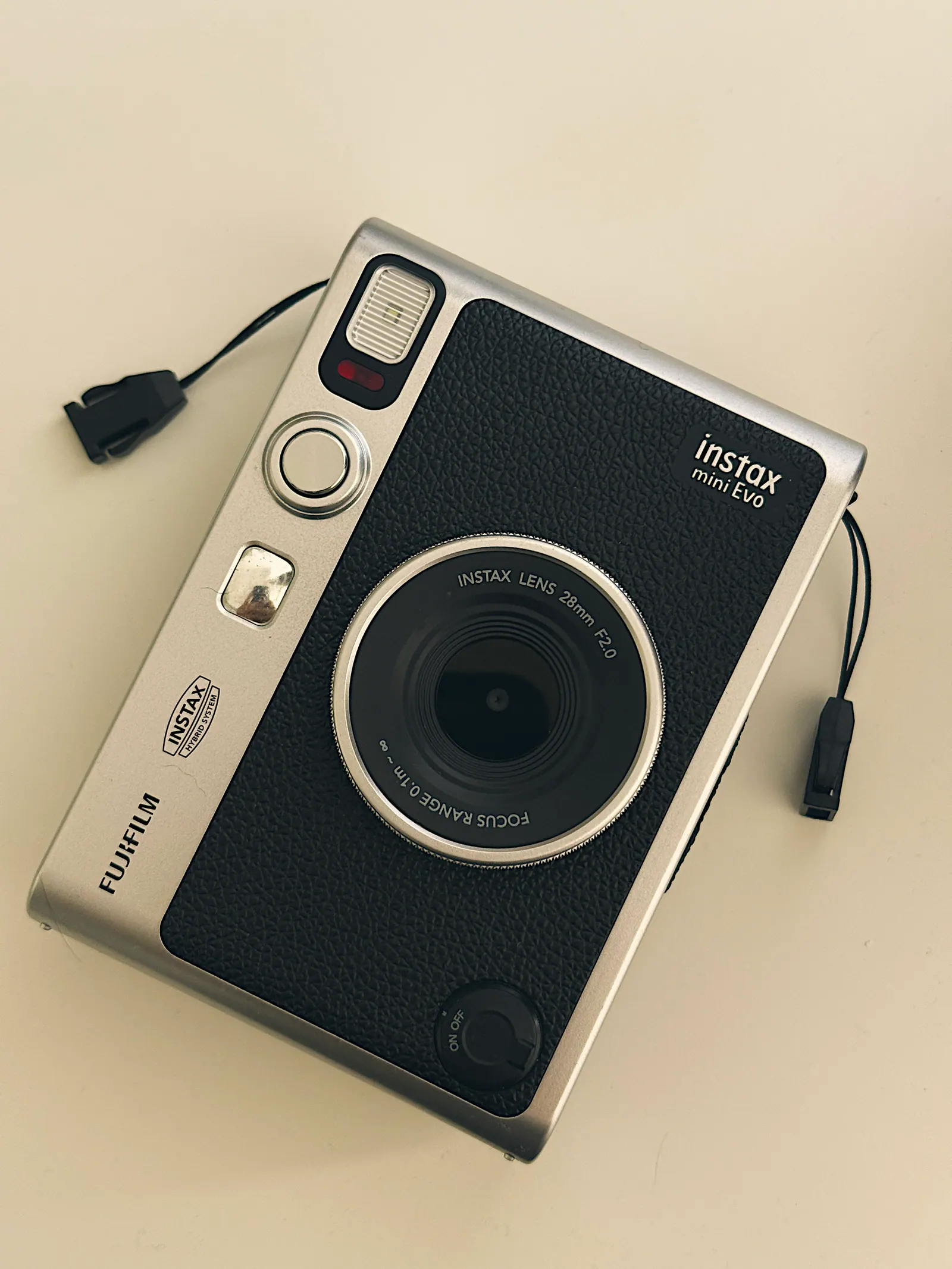
Three Instax bodies have a digital sensor and a screen: mini Evo, mini LiPlay and SQ20. You shoot, you look at the result, you decide whether it is worth a sheet, and only then does it print.
This removes the part that makes instant film frustrating — ten sheets and no undo — and with it part of what makes it interesting. It also adds filters and effects applied before printing, which the purely analogue bodies cannot do.
They cost more than the simple bodies and they need charging rather than batteries. If you hate wasting film, they are the answer. If the commitment is the appeal, they are not.
You can skip the camera entirely
Fujifilm also makes printers that take the same film and have no lens: you send a photo from your pohne over Bluetooth and it prints. Same sheets, same chemistry, same prints.
For anyone who already owns a proper camera this is the more useful device. You choose every sheet instead of gambling it, and you can print JPEGs from a Fujifilm X body with a film simulation recipe already baked in — a Fujifilm colour profile on Fujifilm instant stock.
The catch is arithmetic: X-series cameras shoot 3:2, mini is about 4:3 and square is 1:1, so crop deliberately before sending or the app crops for you.
Is it worth it
Ten shots a pack, no deleting, and a per-shot cost you can feel. That is the deal, and whether it is good depends entirely on what you want from it.
It is worth it if you want objects — prints to give away, stick on a wall, put in a book. Nothing digital replaces handing someone a photograph they now own.
It is not worth it if you want good photographs of specific things in difficult light. It will lose to your phone on almost every technical measure, and it is not trying to win.
The constraint is the product. Ten frames makes you look before you press, and that turns out to be the part people keep coming back for.
Common questions
How does Instax film actually develop?
Each sheet holds three light-sensitive layers plus a reservoir of chemistry in the thick white border. As the camera ejects the sheet, two steel rollers burst that reservoir and spread it evenly across the sheet, which develops all three layers at once. It takes about 90 seconds and stops itself.
Should I shake an Instax photo?
No. The chemistry is a wet layer spreading inside a sealed sheet, and shaking moves it around and leaves blotches. Lay the print face down for the first minute instead.
Is Instax the same as Polaroid?
No, and the films are not interchangeable. Polaroid prints are larger and square, take several minutes to develop and vary more; Instax is smaller, develops in about 90 seconds, renders cleaner, and costs much less per shot in mini format.
Why do my Instax photos look washed out compared to my phone?
Instax has a much narrower dnyamic range than a digital sensor, so a bright sky and a shadowed face cannot both survive in one frame. The pastel highlights and warm, soft colour come from the chemistry rather than from a setting.
Do I need an Instax camera to use Instax film?
No. Fujifilm makes printers that take the same packs and print photos sent from a phone over Bluetooth, which is usually the better choice if you already own a camera you like.
Keep reading
Last updated September 15, 2026