Gear · 8 min read
Lens Filters for Fujifilm: ND, Polariser and What to Skip
Two filters worth owning, the sizes that fit, and the ones a recipe already does better.
Short answer
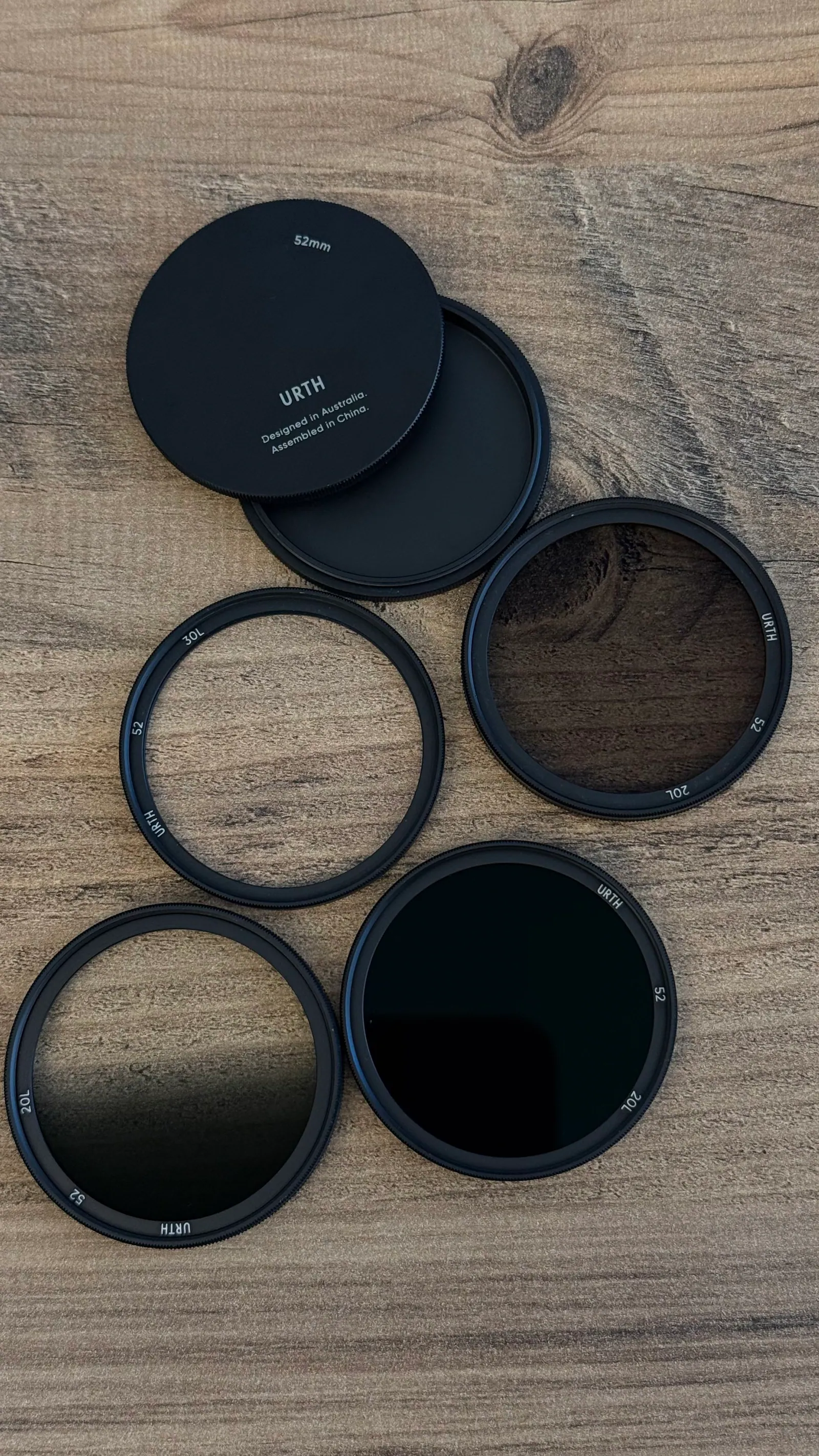
Buy a circular polariser and a 6-stop ND, both in 72mm — the largest thread in the Fujinon range — then use step-up rings for smaller lenses. Skip colour filters: a white balance shift does the same job for free. If you shoot an X100 you need the adapter ring first, because the lens has no filter thread at all.
Most filter guides list twenty products. This one starts from the opposite end: on a Fujifilm, almost everything a filter used to do is now a setting, and exactly two filters are left that a setting cannot imitate. Here is what those two do, which size to buy so one filter fits your whole kit, and what the rest of the shelf is for.
The only two filters that do something a setting cannot
On a Fujifilm this question has a sharper answer than on most cameras, because so much of what filters used to do now lives in the camera. A warming filter is a white balance shift. A contrast filter for black and white is the ACROS filter variant. Anything that changes colour is better done in a recipe, where it costs nothing and you can undo it.
Two filters change the physics of the exposure instead, and no setting can imitate them:
An ND filter removes light. That lets you keep a wide aperture in bright sun, or hold the shutter open long enough to blur water and crowds.
A polariser removes reflected light selectively. It cuts glare off water, glass and wet leaves, and deepens a blue sky — because sky light is polarised and your sensor cannot tell the difference. This is the one effect that genuinely cannot be added afterwards.
Everything else on the shelf is either protection or a special effect.
ND: what the numbers mean
ND strength is quoted two ways and the numbers look unrelated until you see the pattern. The number after ND is how many times less light gets through; the stops are what you set on the dial.
ND8 is 3 stops. ND64 is 6 stops. ND1000 is 10 stops. Each tripling of the number is roughly another handful of stops, because the scale doubles per stop.
What each is for:
3 stops is the video filter. If you shoot 25p or 30p you want the shutter near 1/50 or 1/60 to keep motion looking normal, and in daylight that forces you to f/16 where the lens is at its worst. Three stops buys you back f/5.6.
6 stops is for moving water in daylight — a stream goes from frozen to silk at around half a second.
10 stops is for minute-long exposures: cloud turned into streaks, a busy square emptied of people. It is a specialist tool and it will need a tripod, so buy it last.
If you only buy one, buy 6 stops. It covers daylight long exposure, and you can stop down a little to fake three.
Polarisers: the strongest filter and the fussiest
A polariser is not a strength you pick, it is an angle you rotate. Turn the front ring while looking through the viewfinder and you watch reflections appear and disappear. There is no correct setting — there is the position that removes what you want removed.
It works best at roughly ninety degrees to the sun and does almost nothing pointing straight at it or straight away. That is physics, not a defect.
Two costs worth knowing before you buy. It eats between one and two stops of light, always, even when rotated to do nothing. And on very wide lenses the effect is uneven: because the polarisation angle changes across a wide field, a sky can come out dark on one side and pale on the other. On X mount that starts to show below about 16mm, which is 24mm equivalent. On a 23mm or longer it is a non-issue.
Buy a circular polariser, not linear. Autofocus and metering need the circular kind.
UV and protection filters: the honest answer
A UV filter does nothing optical on a digital camera. The sensor already sits behind a filter stack that blocks ultraviolet. The glass you are buying is flat, clear and has no effect on the picture.
That is not the same as useless. It is insurance: a twenty-dollar element takes the scratch, the sand and the fingerprint instead of the front group of your lens. On a weather-sealed lens it also completes the seal at the front, which some Fujinon designs expect.
The catch is that it is the one piece of glass in front of everything else. A cheap protection filter on a good lens will give you flare and ghosting around every street light, and you will blame the lens. If you use one, buy a coated one from a maker you have heard of, or do not use one at all.
Variable ND: convenience with a limit
A variable ND is two polarisers turned against each other, which is why it covers a range instead of a fixed strength. Typically two to five stops, or six to nine on the stronger ones.
It is genuinely convenient for video, where the light changes between shots and swapping filters is not an option. The limit is at the far end of the range: pushed to maximum, two crossed polarisers darken unevenly and leave a soft X across the frame. It is worst on wide lenses and invisible in the middle of the range.
Practical rule: buy a variable ND for video and stay off the last third of the dial. For stills, fixed ND is cheaper and cleaner.
Which size actually fits your lenses
Filters screw into the front of the lens and the thread size has nothing to do with the focal length. Two 56mm lenses in this catalogue take different filters.
Across the Fujinon and third-party lenses whose thread we have verified, eight different sizes turn up: 39, 43, 46, 52, 58, 62, 67 and 72mm. The most common is 58mm; the largest is 72mm, which is what the standard zooms take — XF16-55mm, XF16-80mm, XF10-24mm and XF50-140mm.
This is why you buy one good filter, not five. Buy it in 72mm, the largest thread in your kit, then use step-up rings for everything smaller. A 58–72 ring costs a few dollars and one 72mm polariser then fits every lens you own.
Step-up only. Putting a smaller filter on a larger lens with a step-down ring will vignette, and no amount of cropping fixes a dark circle in the corners.
Every lens page here lists its filter thread where the maker publishes it. Check yours before ordering.
If you shoot an X100
The X100 series is the exception, and it catches people out. The lens has no filter thread at all — the front ring is decorative and unscrews to reveal a bayonet, not a thread.
To use filters you need the adapter ring, which replaces that trim ring and gives you a 49mm thread. Fujifilm sells it alone and as part of the hood kit. Without it there is nowhere to screw a filter on and this applies to every X100 from the original through the X100VI.
Because 49mm is small and the lens is a 35mm equivalent, a polariser here is straightforward: no uneven sky, no vignetting, and the fixed focal length means one filter covers your whole camera.
What to skip
Colour and warming filters. A white balance shift does the same job, costs no light, and you can change your mind. On a camera with a shift grid this is the easiest decision on the list.
Star, soft-focus and diffusion filters. Real effects, but permanent ones baked into the frame. Try them after you own an ND and a polariser, not before.
Filter kits under thirty dollars. Ten filters for the price of one means ten pieces of uncoated glass. The money is better spent on one filter you will not have to explain.
A second polariser in a different size. Step-up rings exist.
Buying order
If you are starting from nothing, in this order:
1. A circular polariser in your largest thread. It does the one thing nothing else can, and it works in the light you already shoot in
2. Step-up rings for your other lenses. Cheaper than a second filter and they arrive in a set.
3. A 6-stop ND when you want water to move. Or a variable ND instead, if you shoot video.
4. Protection filters only for the lens you take to the beach.
That is two purchases and a bag of rings. Everything past it is a specific problem you will recognise when you have it.
Common questions
Do I need a UV filter on a digital camera?
Not optically. The sensor already sits behind a filter stack that blocks ultraviolet, so UV glass changes nothing in the picture. It is protection and only worth it if you buy a coated one — a cheap filter in front of a good lens causes flare around point lights.
Which ND strength should I buy first?
Six stops. It handles daylight long exposure of water, and stopping the aperture down a little covers what a three-stop filter would do. Buy the ten-stop later, if at all.
Why does my polariser darken the sky unevenly?
The polarisation angle changes across a wide field of view, so a wide lens sees different amounts of polarised sky on each side. On X mount it starts to show below about 16mm, which is 24mm equivalent. On longer lenses it does not happen.
Can I use one filter on all my lenses?
Yes, if you buy it in the largest thread you own and use step-up rings for the rest. In the Fujinon range the largest common thread is 72mm, used by the standard and telephoto zooms. Step-up works; step-down vignettes.
Do filters work on the X100VI?
Only with the adapter ring. The X100 lens has no filter thread — the decorative front ring unscrews to a bayonet. The adapter replaces it and gives a 49mm thread. This is true of every X100 generation.
Keep reading
Last updated September 15, 2026